
Quick read: 2026 is the most consequential year for drones since DJI launched the Phantom in 2013. Beyond-line-of-sight flight is finally legal in the US, AI is replacing manual piloting for most use cases, drone delivery has crossed from pilot programs to real revenue, and a new wave of sub-250g drones is dominating consumer sales. Here's what every pilot, hobbyist, and operator needs to know.
The drone industry has always moved fast, but the shifts happening in 2026 are different. They are structural, not incremental. Regulations that took a decade to negotiate just went live. AI features that were research papers in 2023 are now shipping in $400 consumer drones. And the geopolitical tug-of-war over DJI is finally producing real alternatives at competitive prices.
If you fly drones recreationally, professionally, or you are just thinking about buying your first one, the next twelve months will reshape what is possible — and what is legal. Here are the ten trends we are watching most closely.
1. FAA Part 108 makes BVLOS legal nationwide
The single biggest regulatory change in drone history quietly went live in early 2026. Part 108 — the FAA rule allowing routine beyond-visual-line-of-sight (BVLOS) flight without case-by-case waivers — has been in negotiation since 2018. It is finally here.
What this unlocks: long-distance pipeline inspection, infrastructure surveys, agricultural monitoring across thousands of acres, search-and-rescue patrols, and most consequentially, scalable drone delivery. Operators no longer need to file individual Part 107 waivers for every BVLOS mission. The framework defines aircraft requirements, pilot certifications, and risk-based operating zones.
For hobbyists, Part 108 does not change recreational rules — your sub-250g drone still flies the same way. But for anyone considering a commercial drone career, the addressable market just multiplied. Industry analysts at McKinsey project the US commercial drone services market will grow from $4.2 billion in 2025 to $14 billion by 2028, almost entirely on the back of Part 108 unlocking new use cases.
2. AI-powered autonomous flight is now standard, not premium
Two years ago, autonomous obstacle avoidance and subject tracking were premium features in $1,500+ drones. In 2026, they are table stakes for any drone over $400.
The DJI Mini 5 Pro, released late 2025, includes ActiveTrack 6.0 with neural network-based subject identification — it can lock onto and follow a specific person even in a crowded scene. Skydio's X10 takes this further with full mission-level autonomy: tell it to inspect a cell tower, and it figures out the flight path, captures the imagery, and lands itself.
What changed is the underlying technology. Edge AI chips have become small enough and efficient enough to run real-time computer vision on a sub-250g drone. Models that required cloud connectivity in 2023 now run locally on the aircraft. The practical effect: beginner pilots can capture footage that would have required a skilled professional five years ago.
3. Drone delivery crosses the chasm from pilot to real revenue
For years, drone delivery was the technology that was always five years away. In 2026, it has actually arrived — though probably not in the form anyone expected.
Walmart now operates drone delivery from over 200 stores in five states, completing more than 1.2 million deliveries in 2025 alone. Wing (Alphabet's drone subsidiary) does over 4,000 deliveries per day across DFW, Dallas-Fort Worth and Brisbane. Amazon Prime Air, after years of stumbles, finally hit operational scale in late 2025 with their MK30 drone certified for residential delivery.
The economics are also working. Walmart reports a per-delivery cost of around $1.30, well below the $4–$6 cost of last-mile gig delivery. The unlock was not bigger drones or longer ranges — it was Part 108 BVLOS combined with route optimization software that lets a single operator monitor a fleet of 30+ drones simultaneously.
What this means for you depends on where you live. If you are in a participating market, expect drone delivery to become as routine as DoorDash by 2027.
3. Anti-drone tech is now a $4 billion industry
For every advance in drone capability, there is a parallel arms race in counter-drone technology. The Ukraine war accelerated this dramatically, but in 2026 it has become a major civilian sector too.
Airports, prisons, stadiums, power plants, and government buildings increasingly deploy radio-frequency detection, radar systems, and (where legal) jamming or net-interception tools. The FAA's reauthorization bill expanded counter-UAS authority to state and local law enforcement, which has triggered massive procurement programs.
For recreational pilots, the practical impact is more enforcement of existing no-fly zones. Airports now detect and trace unauthorized drones in real time. Flying near a stadium during an event will get you visited by law enforcement. The FAA's Remote ID requirement, fully enforced since 2024, means your drone is broadcasting its location whether you know it or not.
4. Solid-state batteries debut in consumer drones
The lithium-polymer battery has been the bottleneck on drone flight time for over a decade. In 2026, that is finally changing.
Autel's EVO Lite Plus, refreshed in early 2026, is the first consumer drone shipping with a semi-solid-state battery. The result: 47 minutes of flight time in a sub-1kg package — a 40% improvement over the previous generation with the same form factor. DJI is rumored to debut their own solid-state cells in the Mavic 4 Pro later this year.
Solid-state matters for more than flight time. The cells are safer (no thermal runaway risk), tolerate more charge cycles, and perform better in cold weather. For commercial operators, this dramatically improves the unit economics of drone delivery and inspection. For hobbyists, it means a third battery in your bag instead of six.
5. Drone swarms replace fireworks at major events
If you watched any major event in 2025 — Super Bowl halftime, the Paris Olympics opening, New Year's Eve in Times Square — you saw the drone shows. In 2026, this has become mainstream. Over 800 cities globally have hosted drone shows in the past 18 months.
The economics are why. A 500-drone show costs around $80,000 to produce. The equivalent firework display costs $250,000+ and produces noise, smoke, debris, and wildfire risk. Drone shows are quieter, more programmable, and increasingly the default for civic celebrations.
The technology has also matured. Companies like Verge Aerospace and Sky Elements now operate fleets of 1,500+ synchronized drones, with redundancy systems that allow individual aircraft failures without affecting the show. Each drone weighs around 250 grams and uses RTK positioning for centimeter-level precision.
6. The sub-250g consumer category dominates
The single most important number in consumer drones is 249 grams. Drones below that weight in most countries face dramatically reduced regulation: no mandatory registration in many markets, fewer no-fly zone restrictions, no Remote ID broadcast requirement in some jurisdictions. The result has been a wave of innovation packing more capability into less weight.
The DJI Mini 5 Pro, Autel EVO Nano+ 2, and Potensic Atom 2 all weigh under 250 grams while capturing 4K HDR video, supporting 30+ minute flight times, and offering autonomous tracking features. The category now accounts for roughly 60% of new consumer drone sales, up from 35% in 2023.
For new pilots, this is mostly good news. Beginner-friendly drones are now affordable, capable, and legal to fly almost anywhere. The downside: as more drones operate without registration, enforcement of bad actors becomes harder.
7. 5G changes what drones can do
Cellular-connected drones are not new — DJI's enterprise lineup has supported 4G modems for years. What is new in 2026 is 5G, and specifically the network slicing and ultra-low-latency capabilities that 5G enables.
For BVLOS operations, this is huge. A drone can now stream 4K HDR video to a remote pilot 1,000 miles away with under 100ms of latency. Real-time AI inference can happen in the cloud rather than on-board. Multiple drones can coordinate via the network rather than direct radio links. T-Mobile launched a dedicated drone-data plan in late 2025; Verizon followed in Q1 2026.
The implication for hobbyists is limited — recreational flight does not need 5G. But for the commercial sector, network-connected drones are quickly becoming the default architecture for any operation beyond a single visual-line-of-sight pilot.
8. Agricultural drones are the quiet giants
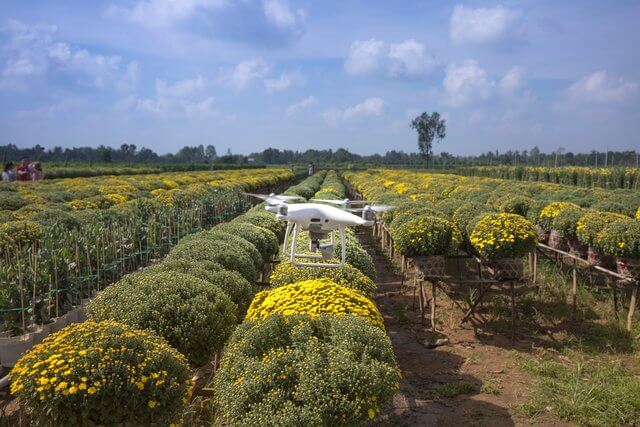
While consumer drones get the headlines, agricultural drones are the largest commercial drone category by spending — and growing fastest. The global ag-drone market hit $7.2 billion in 2025, on track for $11+ billion in 2026.
What's driving it: drones that can carry 50+ kg payloads of pesticide or fertilizer, AI crop analysis that identifies disease and water stress at sub-meter resolution, and integrated workflows where a single pilot manages hundreds of acres per day. DJI's Agras T50 and XAG's P150 dominate the hardware side; Climate Corporation, Taranis, and Granular dominate the software.
For farmers, the unit economics are now compelling at almost any scale. A $25,000 drone replaces $80,000+ of tractor passes per season on most row crops. The IRS has approved drone purchases for Section 179 deduction, accelerating adoption further.
9. The DJI question gets answered (sort of)
The geopolitical tug-of-war over DJI continues, but 2026 brought clarity that has been missing for years. The Pentagon's blue-list approved drones (US-made or allied-country-made) now includes credible alternatives in every product category: Skydio for prosumer and enterprise, Brinc for tactical, BRINC's Lemur 2 for first-responder, AgEagle for agricultural mapping, and Anzu Robotics (rebadged DJI hardware with US-controlled software) for general commercial.
For consumers, DJI remains the dominant brand and still offers the best price-performance ratio in most categories. But for government contracts, public safety operators, and enterprises with security requirements, real alternatives now exist. The Texas DPS, several state police forces, and the US Army have all switched away from DJI in the past 18 months.
Whether DJI gets formally banned for consumer use remains an open question. The latest legislation pushes a decision to 2027. In the meantime, hedging your investment by learning multiple platforms is increasingly the smart play.
10. The training and certification boom
One last trend worth flagging: the Part 107 commercial pilot certification has become the fastest-growing FAA license category. Over 350,000 active Part 107 pilots in the US as of Q1 2026, up 28% year-over-year. Part 108 will only accelerate this.
What this means: drone work has evolved from a hobby-side-hustle to a real career path. Average rates for skilled commercial pilots range from $75–$200 per hour for inspection work, $300–$600 per hour for cinematography, and $500+ per hour for niche specialties like wind turbine blade inspection or thermal imaging.
For anyone looking to build a drone career, the supply-demand dynamics are favorable. Demand is growing faster than the certified pilot pool. Specialized skills (RTK surveying, thermal imaging, BVLOS operations) command premium rates. The barrier to entry is modest — a Part 107 certification costs around $175 and a few weeks of study.
What this means for you
The pace of change in drone technology and regulation has never been faster. Whether you fly recreationally, professionally, or are considering your first purchase, here is what we recommend:
- If you are a hobbyist: Stick to sub-250g consumer drones. Stay updated on local regulations — they are changing fast. Consider Part 107 certification even for hobby use; it expands what you can do legally.
- If you are a professional pilot: Diversify your platform skills beyond DJI. Get familiar with Skydio, Autel, and the Anzu/blue-list ecosystem. Watch for Part 108 BVLOS opportunities in your region.
- If you are buying your first drone: The DJI Mini 5 Pro or Autel EVO Nano+ 2 remain the best starting points. Both pack pro-grade features into sub-250g packages. Our beginner drone guide walks through the buying decision in detail.
- If you operate drones commercially: Start preparing for Part 108 now. The certification process is more complex than Part 107. Operators who certify early will have first-mover advantage in their markets.
The bottom line
2026 will be remembered as the year drones finally crossed from emerging technology to embedded infrastructure. Delivery, inspection, agriculture, public safety, and entertainment are all being reshaped simultaneously. The pace will not slow down — if anything, the regulatory clarity from Part 108 has unlocked a wave of investment that will compound through the rest of the decade.
For our part, we will keep testing every drone that lands on our desk, calling out hype where we see it, and helping pilots — beginners through professionals — navigate the changes. If there is a specific trend or technology you want us to dig into, let us know.